STAFF SPOTLIGHT: Anne Baker
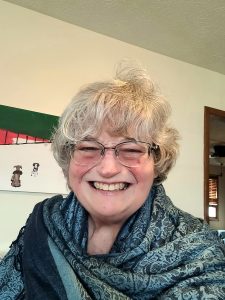
Anne Marie Baker is a native of Omaha, Nebraska. The baby of four, she is the only member of her family to ever move out of the city. It’s a difference in life preferences, she thinks.
“I had more of a wanderlust,” she said. “So I wanted to see what else was out there.”
This curiosity she attributes to reading. Anne would read anything growing up.
“My folks had Reader’s Digest condensed books,” she explained. “They take books and condense them down. So I read all of those.”
She also would spend time at the library and borrow her brother’s mystery novels. These days, she mostly listens to audiobooks instead, but she continues to be interested in mysteries. Recently, she finished a book by Lee Child and is about to start The Personal Librarian by Marie Benedict and Victoria Christopher Murray, which is not mystery per se, but does have quite a lot of intrigue.
Anne has an adorable smile. I have always loved to see the way her eyes crinkle when her cheeks are drawn upward by a joke or the recollection of something that delights her. Her smile, itself, is a mystery. What is behind it? It turns out, there are a few things.
The biggest one might be a personal challenge. Three years ago, Anne had surgery for a condition called pulmonary hypertension. It was first diagnosed in 2019 and in 2023, doctors at Barnes-Jewish hospital operated on her.
Pulmonary hypertension is when a person has high blood pressure specifically in the arteries that supply their lungs. The condition made Anne feel like a zombie both physically and mentally, but the surgery was life changing.
“It’s amazing how your mind starts to return if your lungs are getting blood and your mind is getting oxygen,” she said. “I feel more like myself than I have probably since 2017. People talk about certain points of their life. For everybody, COVID was kind of the dividing line. My surgery was my dividing line. My before and after.”
She spent several months recovering in the hospital, including about five weeks in the ICU on a life-support machine called an Extracorporeal Membrane Oxygenation (ECMO), which kept her going. Often, this machine can cause significant damage to patients’ limbs, in addition to many other long-term complications. Anne, however, has only sustained sensation loss in the tip of one finger.
“Of all the things that happen to other people, this is nothing. Of all the things that could have gone wrong, this is so minor,” Anne said. “I am really one of the luckiest people around. All this is happening, I’m still here.”
Now she is back to doing the thing she loves: working in the archives.
Anne’s career started at the University of Denver, where she studied history. During college, she worked part-time in her department and her professor taught her archival work. Seeing the sort of materials her professor got to work with fine-tuned Anne’s own ambition. She always knew she wanted to work in a library and so she got her masters in library science from the University of Maryland College Park, specializing in archival work.
Her first job was in western South Dakota at the South Dakota School of Mines and Technology. Without even seeing the campus, Anne accepted that job and moved out west. This was the first of many grant-funded positions she took. Then, another grant-funded position opened up in the Black Hills area at the Adams Museum in Deadwood.
The Adams Museum was started in 1930 and it specialized in local history, particularly the gold rush, mining history, Native American history, and more.
“Wild Bill Hickok was killed there in Deadwood—the final shootout that he had. So there’s a lot of history up there,” she said.
At the museum, Anne didn’t make much money, she gave up her benefits, and she knew this wasn’t exactly what she wanted to do with her career, but she took the job because it looked fun and she worked there for two years. After that, she took a grant-funded archival administration fellowship at the National Historic Publications and Records Commission (NHPRC), which placed her at the Wisconsin Historical Society in Madison for a year, where she learned how to run an archive. Next she moved to a grant-funded position in Western Massachusetts at Williams College.
“I refer to myself sometimes as an itinerant archivist in my early years,” Anne recalled. “Because I just kind of followed, you know, what was out there.”
Her personal life took her on a detour for a few years. She worked for the local county tax assessor and held other temp jobs before moving to Springfield and working for the History Museum before it was the History Museum on the Square. At that time, it was housed inside Historic City Hall. After working there for a few years, she got a job as a general archivist at Missouri State University. June 1, 2026 will mark 25 years in Special Collections & Archives.
“I had my career back,” Anne said. “I love this job. This kind of work is something I wanted to do forever.”
Anne is now Head of Special Collections & Archives, a position she took over in 2018 from her once-and-future boss, Dave Richards. She loves working with historical materials and having diversity in her duties. She does exhibits, processing collections, working with researchers and donors, and more.
At the moment, Special Collections is working on several projects, including storing the photographic history of Missouri State University as well as preserving materials from Ozarks Public Television.
Anne is particularly fond of collections and objects acquired from families, like diaries, photographs, and letters. One of her favorite collections is letters between an engaged couple who were stationed in Japan and Korea with the U.S. military. She was a librarian and he was a service member.
“A large part of the reason I like this job is because I do get to help direct what’s happening with our department and help figure out what we need to do, how we should expand,” she said. “And I work with great people. We’ve got a great team here.”
Outside of work, Anne spends a lot of time with her dog, Dorothy, a beagle who used to be bred repeatedly for a puppy mill and who Anne rescued.
“I knew I wanted a beagle. I knew I wanted a little older dog,” Anne said. “And she just looked like she needed somebody to love her and be careful with her, be gentle with her, because she was afraid of noises. She’s never going to be a real outgoing dog because she doesn’t know how to. But once in a while, I see that if she’d been raised right as a puppy, she would have had such a good life. She’s going to have a really great retirement home.”
So Anne spoils her. Dorothy goes to doggy daycare and enjoys her treats. She is a princess. Anne prefers creatures who can cuddle. She does not like lizards, would not get a fish, and is terrified of things without legs. (Snakes) As an adult, she has had many beagles (R.I.P. Daphne and Baxter) and one terrier-mix, a girl named Ogden.
Anne also has a great relationship with her family. This month, her older sister is driving down and they’re going to do a Route 66 roadtrip between Springfield and Tulsa, seeing sites and family members. In the summer, Anne will meet up with her siblings and many nieces and their children for an annual reunion at the Missouri River up at the meeting of South Dakota, Iowa, and Nebraska. The spread goes from age 12 up to age 77. They rent out cabins and they’ll play cards. Anne will point out where Lewis and Clark walked. They’ll talk. They’ll walk. One year, they saw the Aurora Borealis.
Anne Baker has a lot of stories. (Of course she does; she’s an archivist.) You could talk to her for hours. You could hear about her family, her community involvement, all the dogs (and humans) she has loved over her life. I encourage you, go sit in her chair and pick her brain for a bit. She has learned a lot in life, but I think the thread that weaves it all together is a feeling of immense gratitude in spite of, and even because of, the fact that life can be difficult. She has a clear-eyed ability to take the measure of a situation and calibrate her mind and her person to that truth.
“It could have been better, it could be worse. A lot of people have it a lot worse,” she said. “As I’ve gotten older, I’m less perturbable. Life is good and you focus on the good.”
It took her a while to get to that place. But that’s where she camps out now.
“Not everything’s perfect, but it could be so much worse,” she said. “And the parts that are good are really good.”